- 소득공제
- 정가제FREE
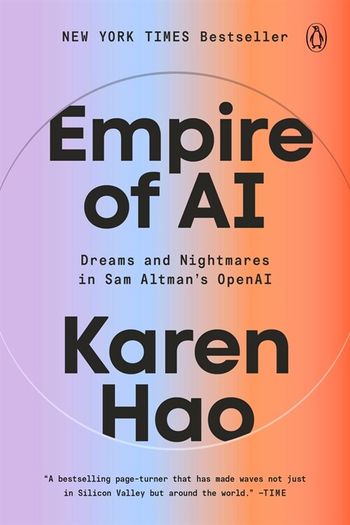
Empire of AI: Dreams and Nightmares in Sam Altmans OpenAI
- Karen Hao
- PENGUIN
- 2026년 05월 19일
5만원 이상 결제 시 (*배송비 제외)
정가제FREE(상품/사은품) 금액이
2,000원 이상이면 2,000원 추가적립10만원 이상 결제 시 (*배송비 제외)
정가제FREE(상품/사은품) 금액이
2,000원 이상이면 2,000원 추가적립정가제FREE(상품/사은품) 금액이
5,000원 이상이면 5,000원 추가적립




회원가입 시 적립금 즉시 지급!
배송안내
- 1만원 이상 주문 시 무료배송 입니다.
- 주문하신 상품을 해외로 배송 하시는 경우에는 별도의 항공료 가 부과됩니다
[주문/배송] 주문 수량 변경 시 안내
주문 수량 변경 시,배송일정이 변경될 수 있으니 반드시 확인해 주시기 바랍니다.
(고객센터 1544-9020)
| ISBN | ISBN-13 : 9780593657522 |
|---|---|
| 쪽수 | 496쪽 |
| 크기 | 기타 규격 |
| 단행본 |
- 외서 전문서적 > SOCIAL SCIENCE


AI추천 이유
A New York Times Notable Book • Finalist for the National Book Critics Circle Award • An Instant New York Times Bestseller • Named a Best Book of the Year by Smithsonian, Scientific American, and Elle • Porchlight 2025 Business Book Award Winner
“A bestselling page-turner that has made waves not just in Silicon Valley but around the world . . . With Empire of AI, Hao is fundamentally shaping many people’s perceptions and understanding of the company at the center of the AI revolution.” ―TIME Magazine, “TIME100 AI 2025”
“Excellent and deeply reported.” ―Tim Wu, The New York Times
“Startling and intensely researched . . . an essential account of how OpenAI and ChatGPT came to be and the catastrophic places they will likely take us.” ―Vulture
From a brilliant longtime AI insider with intimate access to the world of Sam Altman's OpenAI from the beginning, an eye-opening account of arguably the most fateful tech arms race in history, reshaping the planet in real time, from the cockpit of the company that is driving the frenzy
When AI expert and investigative journalist Karen Hao first began covering OpenAI in 2019, she thought they were the good guys. Founded as a nonprofit with safety enshrined as its core mission, the organization was meant, its leader Sam Altman told us, to act as a check against more purely mercantile, and potentially dangerous, forces. What could go wrong?
Over time, Hao began to wrestle ever more deeply with that question. Increasingly, she realized that the core truth of this massively disruptive sector is that its vision of success requires an almost unprecedented amount of resources: the “compute” power of high-end chips and the processing capacity to create massive large language models, the sheer volume of data that needs to be amassed at scale, the humans “cleaning up” that data for sweatshop wages throughout the Global South, and a truly alarming spike in the usage of energy and water underlying it all. The truth is that we have entered a new and ominous age of empire: only a small handful of globally scaled companies can even enter the field of play. At the head of the pack with its ChatGPT breakthrough, how would OpenAI resist such temptations?
Spoiler alert: it didn’t. Armed with Microsoft’s billions, OpenAI is setting a breakneck pace, chased by a small group of the most valuable companies in human history―toward what end, not even they can define. All this time, Hao has maintained her deep sourcing within the company and the industry, and so she was in intimate contact with the story that shocked the entire tech industry―Altman’s sudden firing and triumphant return. The behind-the-scenes story of what happened, told here in full for the first time, is revelatory of who the people controlling this technology really are. But this isn’t just the story of a single company, however fascinating it is. The g forces pressing down on the people of OpenAI are deforming the judgment of everyone else too―as such forces do. Naked power finds the ideology to cloak itself; no one thinks they’re the bad guy. But in the meantime, as Hao shows through intrepid reporting on the ground around the world, the enormous wheels of extraction grind on. By drawing on the viewpoints of Silicon Valley engineers, Kenyan data laborers, and Chilean water activists, Hao presents the fullest picture of AI and its impact we’ve seen to date, alongside a trenchant analysis of where things are headed. An astonishing eyewitness view from both up in the command capsule of the new economy and down where the real suffering happens, Empire of AI pierces the veil of the industry defining our era.
NYT, Financial Times, The Economicst 2025년 올해의 책
2025년 AI 분야 최대의 화제 도서
월스트리트 저널 기자가 파헤친 AI 산업 르포
견제받지 않는 기술 권력은 어떻게 세상을 재편하는가!
현재 세상에서 가장 주목받는 기업 오픈AI와 처음으로 공식 인터뷰를 가졌던 월스트리트 저널 기자 카렌 하오가 실시간으로 지구를 재편하고 있을 정도로 역사상 가장 중대한 기술 패권 경쟁을 조명한다. 하오는 범용 인공지능@AGI@이 인류 전체에 이익이 되도록 보장하겠다는 사명을 내걸고 비영리 조직으로 시작한 오픈AI를 처음에는 선한 세력이라고 생각했다. 하지만 시간이 흐르며 이 거대한 파괴력을 지닌 기업과 산업의 핵심적 진실이 무엇인지 점점 분명히 깨닫게 된다.
챗GPT가 폭발적인 인기를 얻기 시작하자 구글을 비롯한 모든 경쟁 기업들이 오픈AI의 길을 뒤따랐다. 그것은 막대한 스케일링(데이터, 모델의 매개변수, 연산 자원의 규모) 경쟁이었다. 그사이 많은 작가와 예술가들은 자신의 작품을 도용하여 학습한 AI 모델 때문에 일자리를 잃고 있다. 이들의 대형언어모델을 학습시키기 위해 데이터에 주석을 다는 어노테이션 작업은 착취 수준의 임금을 받는 글로벌 사우스의 노동자들에게 맡겨진다. 그런데도 샘 올트먼은 곧 도래할 AGI 또는 초지능 덕분에 미래는 누구도 예측할 수 없을 정도로 밝다고 주장한다.
이 책은 오픈AI라는 한 회사를 넘어 실리콘밸리와 AI산업 전체가 어떻게 권력, 자본, 이데올로기를 기반으로 '제국'처럼 작동하고 있는지를 입체적으로 보여주는 충격적인 AI산업 르포이다.
[본 문]
Prologue
A Run for the Throne
On Friday, November 17, 2023, around noon Pacific time, Sam Altman, CEO of OpenAI, Silicon Valley's golden boy, avatar of the generative AI revolution, logged on to a Google Meet to see four of his five board members staring at him.
From his video square, board member Ilya Sutskever, OpenAI's chief scientist, was brief: Altman was being fired. The announcement would go out momentarily.
Altman was in his room at a luxury hotel in Las Vegas to attend the city's first Formula One race in a generation, a star-studded affair with guests from Rihanna to David Beckham. The trip was a short reprieve in the middle of the punishing travel schedule he had maintained ever since the company released ChatGPT about a year earlier. For a moment, he was too stunned to speak. He looked away as he sought to regain his composure. As the conversation continued, he tried in his characteristic way to smooth things over.
"How can I help?" he asked.
The board told him to support the interim chief executive they had selected, Mira Murati, who had been serving as his chief technology officer. Altman, still confused and wondering whether this was a bad dream, acquiesced.
Minutes later, Sutskever sent another Google Meet link to Greg Brockman, OpenAI's president and a close ally to Altman who had been the only board member missing from the previous meeting. Sutskever told Brockman he would no longer be on the board but would retain his role at the company.
The public announcement went up soon thereafter. "Mr. Altman's departure follows a deliberative review process by the board, which concluded that he was not consistently candid in his communications with the board, hindering its ability to exercise its responsibilities. The board no longer has confidence in his ability to continue leading OpenAI."
On the face of it, OpenAI had been at the height of its power. Ever since the launch of ChatGPT in November 2022, it had become Silicon Valley’s most spectacular success story. ChatGPT was the fastest-growing consumer app in history. The startup’s valuation was on the kind of meteoric ascent that made investors salivate and top talent clamor to join the rocket-ship company. Just weeks before, it had been valued at up to $90 billion as part of a tender offer it was in the middle of finalizing that would allow employees to sell their shares to said eager investors. A few days before, it had held a highly anticipated and highly celebrated event to launch its most aggressive slate of products.
Altman was, as far as the public was concerned, the man who had made it all happen. He had spent the spring and summer touring the world, reaching a level of celebrity that was leading the media to compare him to Taylor Swift. He had wowed just about everyone with his unassuming small frame, bold declarations, and apparent sincerity.
Before Vegas, he had once again been globe-trotting, sitting on a panel at the APEC CEO Summit, delivering lines with his usual dazzling effect.
"Why are you devoting your life to this work?" Laurene Powell Jobs, founder and president of the Emerson Collective and Steve Jobs's widow, had asked him.
"I think this will be the most transformative and beneficial technology humanity has yet invented," he said. "Four times now in the history of OpenAI-the most recent time was just in the last couple of weeks-I have gotten to be in the room, when we sort of push the veil of ignorance back and the frontier of discovery forward, and getting to do that is, like, the professional honor of a lifetime."
Shocked employees learned about Altman’s firing just as everyone else did, the link to the public announcement zipping from one phone to the next across the company. It was the chasm between the news and Altman’s glowing reputation that startled them the most. The company was by now pushing eight hundred people. These days, employees had fewer opportunities to meet and interact with their CEO in person. But his charming demeanor on global stages was not unlike how he behaved during all-hands meetings, at company functions, and, when he wasn’t traveling, around the office.
As the rumor mill kicked into a frenzy and employees doomscrolled X, formerly Twitter, for any shreds of information, someone in the office latched on to what they saw as the most logical explanation and shouted, "Altman's running for president!" It created a momentary release of tension, before people realized this was not the case, and speculation started anew with fresh intensity and dread. Had Altman done something illegal? Maybe it was related to his sister, employees wondered. She had alleged in tweets that had gone viral a month before that her brother had abused her. Maybe it wasn't something illegal but ethically untoward, they speculated, perhaps related to Altman's other investments or his fundraising with Saudi investors for a new AI chip venture.
Sutskever posted an announcement in OpenAI's Slack. In two hours, he would hold a virtual all-hands meeting to answer employee questions. "That was the longest two hours ever," an employee remembers.
Sutskever, Murati, and OpenAI’s remaining executives came onto the screen side by side, stiff and unrehearsed, as the all-hands streamed to employees in the office and working from home.
Sutskever looked solemn. He was known among employees as a deep thinker and a mystic, regularly speaking in spiritual terms with a force of sincerity that could be endearing to some and off-putting to others. He was also a goofball and gentlehearted. He wore shirts with animals on them to the office and loved to paint them as well-a cuddly cat, cuddly alpacas, a cuddly fire-breathing dragon-alongside abstract faces and everyday objects. Some of his amateur paintings hung around the office, including a trio of flowers blossoming in the shape of OpenAI's logo, a symbol of what he always urged employees to build: "A plurality of humanity-loving AGIs."
Now, he attempted to project a sense of certainty to anxious employees submitting rapid-fire questions via an online document. But Sutskever was an imperfect messenger; he was not one that excelled at landing messages with his audience.
"Was there a specific incident that led to this?" Murati read aloud first from the list of employee questions.
"Many of the questions in the document will be about the details," Sutskever responded. "What, when, how, who, exactly. I wish I could go into the details. But I can't." Anyone curious should read the press release, he added. "It actually says a lot of stuff. Read it maybe a few times."
The response baffled employees. They had just received cataclysmic news. Surely, as the people most directly affected by the situation, they deserved more specifics than the general public.
Murati read off a few more questions. How did this affect the relationship with Microsoft? Microsoft, OpenAI's biggest backer and exclusive licensee of its technologies, was the sole supplier of its computing infrastructure. Without it, all the startup's work-performing research, training AI models, launching products-would grind to a halt. Murati responded that she didn't expect it to be affected. They had just had a call with Microsoft's chief executive Satya Nadella and chief technology officer Kevin Scott. "They're all very committed to our work," she said.
What about OpenAI's tender offer? Employees with a certain tenure had been given the option to sell what could amount to millions of dollars' worth of their equity. The tender was so soon that many had made plans to buy property, or already had. "The tender-we're, um, we're going to see," Brad Lightcap, the chief operating officer, waffled. "I am in touch with investors leading the tender and some of our largest investors already on the cap table. All have committed their steadfast support to the company."
“A bestselling page-turner that has made waves not just in Silicon Valley but around the world . . . With Empire of AI, Hao is fundamentally shaping many people’s perceptions and understanding of the company at the center of the AI revolution.” ―TIME Magazine, “TIME100 AI 2025”
“Excellent and deeply reported.” ―Tim Wu, The New York Times
“Startling and intensely researched . . . an essential account of how OpenAI and ChatGPT came to be and the catastrophic places they will likely take us.” ―Vulture
“Easily one of the most gripping nonfiction books I’ve ever read, it keeps you hanging with cliff-hangers that envelop its dramatic characters, occasionally brave and often cowardly people hired and fired by artificial intelligence company OpenAI. One of the few journalists ever invited to interview OpenAI staff, Hao’s expertise flies off every page, and her dozens of pages of notes and citations back it up. She doesn’t hold back as she unveils the ivory towers and monied meetings driving AI, as well as the unrecognized workers around the globe sacrificing their mental health to build it safer.” —Scientific American
“A bestselling page-turner that has made waves not just in Silicon Valley but around the world . . . With Empire of AI, Hao is fundamentally shaping many people’s perceptions and understanding of the company at the center of the AI revolution.” —TIME Magazine, “TIME100 AI 2025”
“The strength of Karen Hao’s detailed analysis of America’s AI industry, Empire of AI, is that her relentlessly grounded approach refuses to play the game of the AI hype merchants. Hao makes a convincing case that it is wrong to focus on hypotheticals about the future of AI when its present incarnation is fraught with so many problems.” —Jacobin
“Startling and intensely researched . . . an essential account of how OpenAI and ChatGPT came to be and the catastrophic places they will likely take us.” —Vulture
“Excellent and deeply reported.” —Tim Wu, The New York Times
“Hao’s reporting inside OpenAI is exceptional, and she’s persuasive in her argument that the public should focus less on A.I.’s putative ‘sentience’ and more on its implications for labor and the environment.” —Benjamin Wallace-Wells, New Yorker
“Deeply researched, gripping.” —The Economist
“Empire of AI is a powerful work, bristling not only with great reporting but also with big ideas.” —Mat Honan, MIT Technology Review
“Timely and myth-busting . . . well reported . . . doesn’t pull any punches.” —Financial Times
"Easily one of the most gripping nonfiction books I’ve ever read, it keeps you hanging with cliff-hangers that envelop its dramatic characters, occasionally brave and often cowardly people hired and fired by artificial intelligence company OpenAI. One of the few journalists ever invited to interview OpenAI staff, Hao’s expertise flies off every page, and her dozens of pages of notes and citations back it up. She doesn’t hold back as she unveils the ivory towers and monied meetings driving AI, as well as the unrecognized workers around the globe sacrificing their mental health to build it safer." — Brianne Kane, Scientific American
“Well-reported . . . urgent.” —Kirkus
“Our lives are about to be remade by artificial intelligence—or to be more accurate, by a few companies run by a few very self-confident people. If you ever wondered whether all of this is inevitable, whether to believe all the promises of tech luminaries, whether we could save a little bit of our democracy in the age of AI, then read this book!” —Daron Acemoglu, Institute Professor, MIT, and recipient of the 2024 Nobel Prize in Economic Sciences
“With devastating revelations, deep insider research, and delightful page-turning delivery, Karen Hao shows us why she is one of the foremost tech journalists covering AI. From data centers in Chile to data workers in Kenya, Empire of AI reveals the hidden human and environmental costs behind AI products that have triggered a race for land, water, and cheap labor to cement power in the hands of a few. Empire of AI is the warning we need—just as more open and less energy-intensive alternatives reveal that a different AI future is possible and achievable.” —Dr. Joy Buolamwini, founder of Algorithmic Justice League and best-selling author of Unmasking AI
“In her brilliant book, Empire of AI, Karen Hao chronicles the mania surrounding artificial intelligence and OpenAI. With a cast of scientists, scammers, and scoundrels, Empire of AI documents the hype campaign that caused the world to fall in love with a technology whose immediate harms are legion and benefits remain unproved.” —Roger McNamee, New York Times-bestselling author of Zucked
"Karen Hao's Empire of AI is an epic exposé that pulls back the curtain on the egos and uneasy compromises behind the rise of OpenAI and ChatGPT. It's full of dark details, some of them bordering on absurd, that shows how much of the AI boom runs on secrecy and is driven by questionable ideologies. This book serves as a warning about the price we all pay when AI builders who dreamed of utopia got swept up in a race to build empires instead.” —Parmy Olson, Bloomberg columnist and author of Supremacy: AI, ChatGPT and the Race That Will Change the World
“Empire of AI is a heroic work. Karen Hao braved many obstacles with gritty determination as she traveled the yellow brick road to the Oz of the storied corporation OpenAI to bring us this work of essential public education. Her courage was rewarded with truth. Altman, a cunning young man with outsized ambition and excellent ‘people skills,’ condemned the world to the digital violence of an approach to ‘artificial intelligence’ that can only exist by devouring the totality of the world's information and then the world itself. Mr. Altman was no wizard, and the seers of our digital future had little vision beyond their own baseless rhetoric and the billions of dollars from greedy or guileless investors. Hao is a gifted journalist and a deep thinker who reveals the historical significance and societal consequences of Silicon Valley’s AI spectacle, even as she meticulously documents a company and its leader hellbent on getting there first with no idea where they are going. If you think the digital future is safe in the hands of brilliant scientists, smart investors, and earnest political leaders, read this book and think again.” —Shoshana Zuboff, author of The Age of Surveillance Capitalism, Charles Edward Wilson Professor Emeritus, Harvard Business School
등록된 리뷰가 없습니다
첫번째 리뷰어가 되어주세요
| 반품/교환방법 | |
|---|---|
| 반품/교환 가능기간 |
|
| 반품/교환비용 |
|
| 반품/교환 불가 사유 |
|
| 상품 품절 |
|
| 소비자 피해보상 환불지연에 따른 배상 |
|